Loading

$149$299
Get the Starter Kit — $149Complete OB emergency readiness for L&D nurses
Know what to watch, what to say, and what to chart — before the room turns critical.
Recognize deterioration sooner, escalate with word-for-word SBAR scripts, and document defensibly when seconds count — the complete Starter Kit plus the coaching app, built for labor & delivery nurses.
Everything you get
- OB Emergency Command Playbook
- 8 Emergency Command Cards
- Documentation Templates
- Case Drill Workbook
- Rapid Review Quiz Pack
- SBAR / Provider Call Scripts
- Web app dashboard access
$149$299Founding price
Get the Starter Kit — $149
One-time payment · instant access · 7 resources + the full app
Not ready to buy? Get the free Command Manual.
Built by L&D and OB clinicians · policy-aligned · works on phone, tablet & web
14-day money-back guarantee

Built for L&D nurses, new grads & studentsRecognize · Escalate · DocumentEducational & policy-alignedWorks on web, tablet & phone
8
Emergency modules
140+
Practice questions
27
Pocket command cards
6
Downloadable tools
Built by clinicians
Created by L&D nurses and OB physicians — aligned to the standards hospitals use.




Content is aligned to publicly available maternal-safety guidance. Not affiliated with or endorsed by these organizations.
Who built this
Built by practicing L&D and OB clinicians.
Every module, drill, and script is written and reviewed by our labor & delivery and OB clinical team, and aligned to national maternal-safety guidance from AIM, CMQCC, ACOG, and AWHONN. This is bedside-tested preparedness, not generic content.
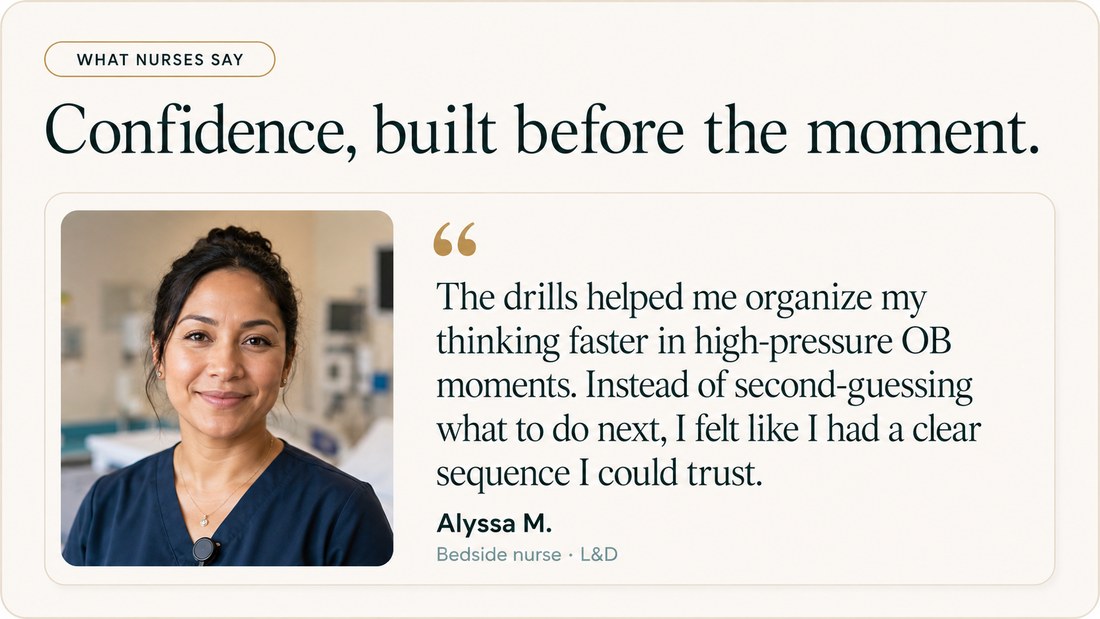
The moment that matters
When a delivery turns into an emergency, hesitation is the risk.
Most nurses don't freeze because they don't care — they freeze because the pattern is unfamiliar and the seconds feel enormous. Matriarch Command builds the recognition, language, and documentation habits before you ever need them, so the response feels practiced instead of improvised.
More than 4 in 5 pregnancy-related deaths in the U.S. are preventable. CDC
Hemorrhage and infection are among the leading causes — and the difference often comes down to how fast the nurse in the room recognizes the shift, escalates, and documents. That readiness is exactly what Matriarch builds.
What nurses practice
The OB emergencies you can't afford to hesitate on.
Postpartum Hemorrhage
Hypertensive Crisis / Eclampsia
FHR Deterioration
Shoulder Dystocia
Cord Prolapse
Amniotic Fluid Embolism
Maternal Sepsis
Emergency Documentation
More than a binder
Matriarch coaches you — it doesn't just hand you a PDF.
Most resources give you files and wish you luck. Matriarch gives you a path, checkpoints, and a readiness score that move you forward the way a coach would.
A gated, linear path
Move through all eight emergencies in order. Each module unlocks only after you finish the one before it — no skipping ahead, no wall of text.
Read, then prove it
Every module ends in a graded Case Drill. Score 80% to complete it, earn your certificate, and unlock the next emergency.
Practice Arena
Spin the wheel for randomized questions across every emergency, build streaks, and get the rationale instantly — a low-stakes warm-up that never touches your graded drills.
A live readiness score
Your readiness ring climbs as you complete modules — the feedback loop a real coach gives you.
Listen between shifts
Every module reads aloud with a built-in player and section markers, so you can review hands-free.
Certificates you earn
A printable certificate for each emergency you pass, plus a program certificate when you complete all eight.
See inside the app
Not a PDF — a coaching app you'll actually use.
Listen to lessons, warm up with randomized practice, prove it on a graded drill, and earn a certificate for every emergency. Here's what it looks like.
Listen
Listen to this module · ~5 min
2:18~5:00
IntroRecognizeRespondEscalate
Listen to any lesson — a full chapter player with section markers and time, so you can review hands-free between shifts.
Certificate of Completion
Postpartum Hemorrhage
Recognize · Escalate · Document
Matriarch Command Passed
Earn a certificate for every emergency you pass — plus a program certificate when you finish all eight.
HemorrhageShoulderAFE
Warm up in the Practice Arena — spin for randomized questions across all eight emergencies, build streaks, and see the rationale instantly.
Case Drill
Question 3 of 10QBL is climbing and the fundus is boggy, but BP still reads normal. What's the earliest reliable signal she's decompensating?
BRising heart rate and symptoms — they shift before BP falls.AWait for hypotension to confirm.
Pass at 80% to unlock the next module.
Prove it with a graded Case Drill — score 80% to complete the module and unlock the next emergency.
Pocket Command Cards
The whole playbook, in your pocket.
A 27-card deck: for every OB emergency, an action card, the exact escalation script to say, and the watch-outs to avoid — plus SBAR, team roles, and your Core 4 path. Swipe them on your phone, or print badge-size and clip them on.
- 27 cards · 8 OB emergencies · digital + printable
- Recognize · Respond · Escalate · Document
- Tap any card to flip to Emergency Command
Add the deck — $47Added to your Starter Kit at checkout.
Action
Postpartum Hemorrhage
Recognize
Rising QBL, boggy fundus, falling BP.
Respond
Massage, quantify, uterotonics; consider TXA.
Escalate — say this
Cord Prolapse
“Cord prolapse, decompression in progress — we need emergent delivery response now.”
Watch-outs
Severe Hypertension
- Don’t chart only the highest pressure.
- Don’t watch BP alone as symptoms worsen.
Every OB emergency framework, in one kit.
$299 value — yours for $149, one-time. Instant access.
What's inside
The OB Emergency Command Starter Kit.
A practical, policy-aligned toolkit built to make recognition, escalation, and documentation feel automatic.
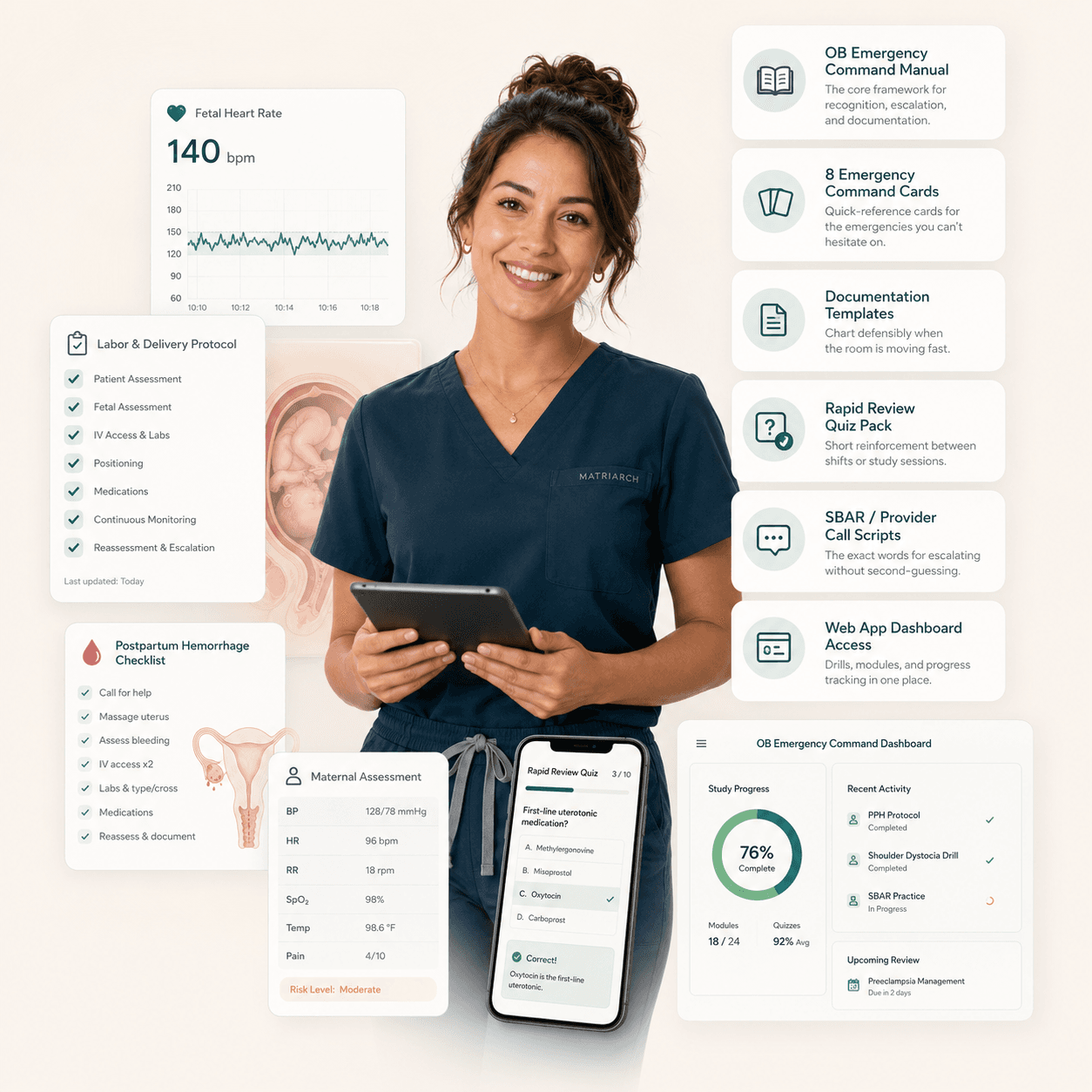
Everything included
- OB Emergency Command PlaybookThe core framework for recognition, escalation, and documentation.
- 8 Emergency Command CardsQuick-reference cards for the emergencies you can't hesitate on.
- Documentation TemplatesChart defensibly when the room is moving fast.
- Case Drill WorkbookTurn recognition and escalation into repeatable habits.
- Rapid Review Quiz PackExam-style questions with rationale for reinforcement between shifts.
- SBAR / Provider Call ScriptsThe exact words for escalating without second-guessing.
- Web app dashboard accessEight gated emergency modules, a graded Case Drill in each, the spin-the-wheel Practice Arena, listen-along module audio, and printable readiness certificates.
How it works
1
Download the free Command Manual
Get the recognition, escalation, and documentation field guide instantly.
2
Find your biggest gap (2-min quiz)
Optional — see the emergency that spikes your stress fastest.
3
Unlock the Starter Kit & dashboard
Work through all 8 modules, warm up in the Practice Arena, pass each Case Drill, and earn your certificates.
Walk into your next shift ready.
Build command before the moment — the full kit for $149, one-time.
Try it risk-free for 14 days.
Work through the modules and drills. If Matriarch Command isn't sharpening your emergency readiness, email us within 14 days for a full refund — no forms, no hassle.
Common questions
Who is the Starter Kit for?
It is built for labor and delivery nurses, transitioning nurses, students, preceptors, and educators who want a structured emergency-readiness framework.
Is this medical advice?
No. It is an educational preparedness resource and must always be used alongside facility policy, provider orders, and clinical judgment.
What happens after purchase?
You get instant account access and your dashboard: the eight gated emergency modules (each ending in a graded Case Drill), the spin-the-wheel Practice Arena, listen-along module audio, printable certificates, and the full download library — the Playbook, command cards, templates, workbook, quiz pack, and SBAR scripts.
Is this a subscription?
No. The Starter Kit is a one-time purchase. You keep ongoing access to your dashboard and downloads.
Start free in 30 seconds
Know what to watch for, what to say, and what to chart.
Get The OB Emergency Command Manual free, then put it to work before your next shift. Not sure where to start? Take the 2-minute quiz.
Clinical Disclaimer
This educational resource is for learning and preparedness only. It does not replace institutional policy, provider orders, clinical judgment, scope-of-practice regulations, or emergency response protocols. Clinicians must follow their facility-specific policies and provider directives.